Google search results change dramatically depending on how you construct your queries. In this article, I’ll walk through the search techniques I use in my day-to-day work – investigating 350+ companies per year across 80+ countries – using US precision sheet metal fabrication as a running example.
“I’m trying to find potential suppliers on Google, but all I get are comparison sites and ads.” “I don’t know how to structure English search queries effectively.” “I can find about 20 companies, but then I hit a wall.”
The problem isn’t Google. It’s how you’re searching. Google isn’t a magic box – it has quirks and biases. Once you understand them and design your queries accordingly, you can find dozens of candidates without spending a dime.
(If you’re interested in our overseas company research services, there’s more information at the end of this article.)
First Things First – Set Google’s Region and Language to Match Your Target Country
Before you even think about keywords, change Google’s search region and language to match the country you’re investigating. If you skip this step, even the best query will return skewed results.
When you use Google from a browser set to your home country, the default search region is local. If you search in English from a Japan-based browser, you’ll get results localized for Japan – not the US. To find American companies, you need to search on America’s Google.
How to change the setting
Go to Google.com and navigate to “Settings > Search settings > Region settings,” then select the target country. If you’re looking for US companies, select “United States.”
This single step optimizes all subsequent search results for your target country. Don’t forget to change the setting back when your research is done.
Note – URL parameters like &gl=us&hl=en used to work for this purpose, but Google now ignores them. Changing the region through the settings page is the only reliable method.
Why this matters
Searching for "sheet metal fabrication" with your region set to Japan versus the United States produces completely different top-10 results. With a Japan setting, you’ll get translated pages and Japanese companies’ English sites mixed in. With a US setting, local manufacturers are prioritized.
| Target Country | Region Setting | Results Language |
|---|---|---|
| United States | United States | English |
| Germany | Germany | German (some English) |
| France | France | French |
| South Korea | South Korea | Korean |
| Mexico | Mexico | Spanish |
Even if you don’t know the local language, always match the region setting to your target country. Company information is heavily influenced by geography, and changing this setting alone makes a significant difference.
Step 1 – Break Down What You’re Looking For Into Concepts, Then Exhaust Every Synonym
The first step in searching isn’t typing keywords. It’s decomposing “what you’re looking for” into distinct concepts, then brainstorming every possible way each concept could be phrased. This step determines the quality of your results.
For example, if you want to find precision sheet metal fabrication companies in the US, break it into three concepts.
Concept A – Country / Region
| Variation | When to use |
|---|---|
| USA | Most common |
| “United States” | Best for phrase searches |
| America | Often used on company profile pages |
| US-based | Means “headquartered in the US” |
| domestic (when searching within the US) | Used in US-origin documents to mean “local” |
Note that “US” is only two characters and too short for standalone phrase searches. Use it with other words – “US-based,” “US manufacturer” – rather than on its own.
Concept B – Product / Technology (This is the most important. Expand it aggressively.)
This concept drives the quality of your search. If you only use “precision sheet metal,” you’ll miss every company that calls the same process by a different name.
Process and technology synonyms
| Variation | Notes |
|---|---|
| “precision sheet metal fabrication” | The most standard term |
| “custom sheet metal fabrication” | Emphasizes custom/made-to-order work. Common among OEM suppliers |
| “CNC sheet metal fabrication” | Emphasizes CNC capability |
| “sheet metal forming” | Covers forming processes broadly – press brake, roll forming, etc. |
| “sheet metal stamping” | Die stamping. For high-volume production |
| “progressive die stamping” | Progressive stamping. Common in automotive parts |
| “deep draw stamping” | Deep drawing. Metal enclosures, containers |
| “laser cutting services” | Laser cutting – a common upstream process in sheet metal work |
| “CNC punching” | NC turret punching. Hole punching and blanking |
| “press brake forming” | Press brake bending |
| “sheet metal prototyping” | Prototyping. For low-volume, high-mix work |
| “sheet metal enclosure” | Enclosures for electronics, electrical equipment |
| “metal cabinet fabrication” | Cabinets for switchboards, control panels |
| “welded assembly” | Welding + assembly. A combined downstream process |
Material-specific terms (when you need to filter by material)
| Variation | Notes |
|---|---|
| “stainless steel fabrication” | Food equipment, medical devices |
| “aluminum fabrication” | Aerospace, lightweight applications |
| “copper fabrication” | Electronic components, heat sinks |
| “titanium fabrication” | Aerospace, medical implants |
Industry classification codes
| Code | Description | How to use |
|---|---|---|
| NAICS 332322 | Sheet Metal Work Manufacturing | US industry classification. Used in government data and business databases |
| SIC 3444 | Sheet Metal Work | Older classification but still widely referenced |
NAICS codes (North American Industry Classification System) are used in US Census Bureau databases and business directories like D&B. Searching "NAICS 332322" on Google returns company lists and industry reports classified under this code.
Concept C – Type of company
| Variation | Notes |
|---|---|
| manufacturer | The most general term |
| fabricator | The standard term in sheet metal and metalworking |
| custom fabricator | Fabricators that do custom/made-to-order work |
| job shop | Small to mid-size shops doing low-volume, high-mix work |
| contract manufacturer | OEM/EMS-style outsourced manufacturing |
| subcontractor | For finding Tier 2 and below suppliers |
| supplier | Buyer-side terminology |
| vendor | Procurement department terminology |
| machine shop | Broader term covering machining and fabrication |
| metal shop | Small-scale shops doing fabrication, welding, and assembly |
If you only use “manufacturer” and “fabricator,” you’ll miss every company that calls itself a job shop, contract manufacturer, or subcontractor. In the US, many small sheet metal companies identify as “job shops” – making this synonym essential.
Certifications and standards (a powerful industry filter)
You can narrow results by certifications relevant to your target industry.
| Certification | Industry | Search keyword |
|---|---|---|
| AS9100 | Aerospace | "AS9100" "sheet metal" |
| ITAR | Defense | "ITAR registered" "sheet metal" |
| ISO 13485 | Medical devices | "ISO 13485" "sheet metal" |
| ISO 9001 | General manufacturing | "ISO 9001" "sheet metal fabrication" |
| NADCAP | Aerospace (special processes) | "NADCAP" "sheet metal" |
If you need aerospace-grade sheet metal fabricators, searching "AS9100" "sheet metal fabrication" USA instantly narrows results to certified companies.
Step 2 – Reverse-Engineer Where the Answers Live
Before constructing your query, think about where the information you’re looking for is likely to exist on the web. Instead of randomly trying keywords, figure out the source first – then search. This is far more efficient.
For precision sheet metal fabricators, the main information sources are as follows.
| Source | URL | What you’ll find |
|---|---|---|
| ThomasNet | thomasnet.com | Company names, locations, products, certifications, employee count |
| FMA member directory | fmamfg.org | Member companies, size, region |
| FABTECH exhibitor list | fabtechexpo.com | Exhibitor lists for the largest North American metal fabrication trade show |
| The Fabricator (trade publication) | thefabricator.com | Company profiles, technical articles |
| PMA member directory | pma.org | Press and sheet metal forming companies |
| Company websites | Various domains | Product details, equipment lists, certifications |
ThomasNet (thomasnet.com) is a manufacturing-focused business directory for North America with detailed product categorization
FMA (Fabricators & Manufacturers Association, International) is a major industry association for sheet metal fabrication in North America
FABTECH is the largest metal fabrication trade show in North America, organized by FMA, and its exhibitor lists are published online
PMA (Precision Metalforming Association) is an industry association for stamping and metalforming
Knowing these sources by name makes a dramatic difference in search efficiency.
Step 3 – Build Queries That Work With Google’s Quirks
There are four fundamental Google search techniques you need to master for company research – exact match quotes, OR operators, exclusion operators, and avoiding generic terms.
Technique 1 – Lock in phrases with double quotes
Wrapping a phrase in double quotes (" ") forces Google to return only results containing that exact phrase. Without quotes, Google returns pages it considers “relevant” – which often means pages that don’t even contain your keywords.
"precision sheet metal fabrication" "USA" manufacturer
In B2B company searches, skipping double quotes produces mostly noise.
Technique 2 – Use OR to cover all synonyms
Connect the synonyms you identified in Step 1 with OR (must be uppercase).
("precision sheet metal" OR "custom sheet metal" OR "CNC sheet metal" OR "sheet metal stamping") ("fabricator" OR "manufacturer" OR "job shop" OR "contract manufacturer") USA
You don’t need to cram every synonym into a single query. Group 3-4 Concept B synonyms together and run multiple searches.
Technique 3 – Remove noise with the minus operator
When results are cluttered with irrelevant pages, use - to exclude them.
"precision sheet metal" fabricator USA -job -career -indeed -glassdoor -salary
Job listing sites are the biggest source of noise in company searches. -job -career -indeed -glassdoor -salary is a standard exclusion set you’ll use in almost every query.
Technique 4 – Avoid generic words
| Word to avoid | Why | Use instead |
|---|---|---|
| company | Matches every industry | manufacturer, fabricator, job shop |
| best | Returns ranking/listicle articles | Don’t use it. Filter by certification instead |
| top | Same problem | Don’t use it |
| metal | Too broad | “sheet metal”, “stainless steel” |
| service | Too vague | “fabrication services”, “laser cutting services” |
Step 4 – Use Shortcuts to Search Smarter
Beyond the basics, there are several operators that let you narrow your search scope efficiently.
site: – Search within a specific website
site:thomasnet.com "precision sheet metal fabrication"
Google’s site: operator is more flexible than ThomasNet’s own internal search.
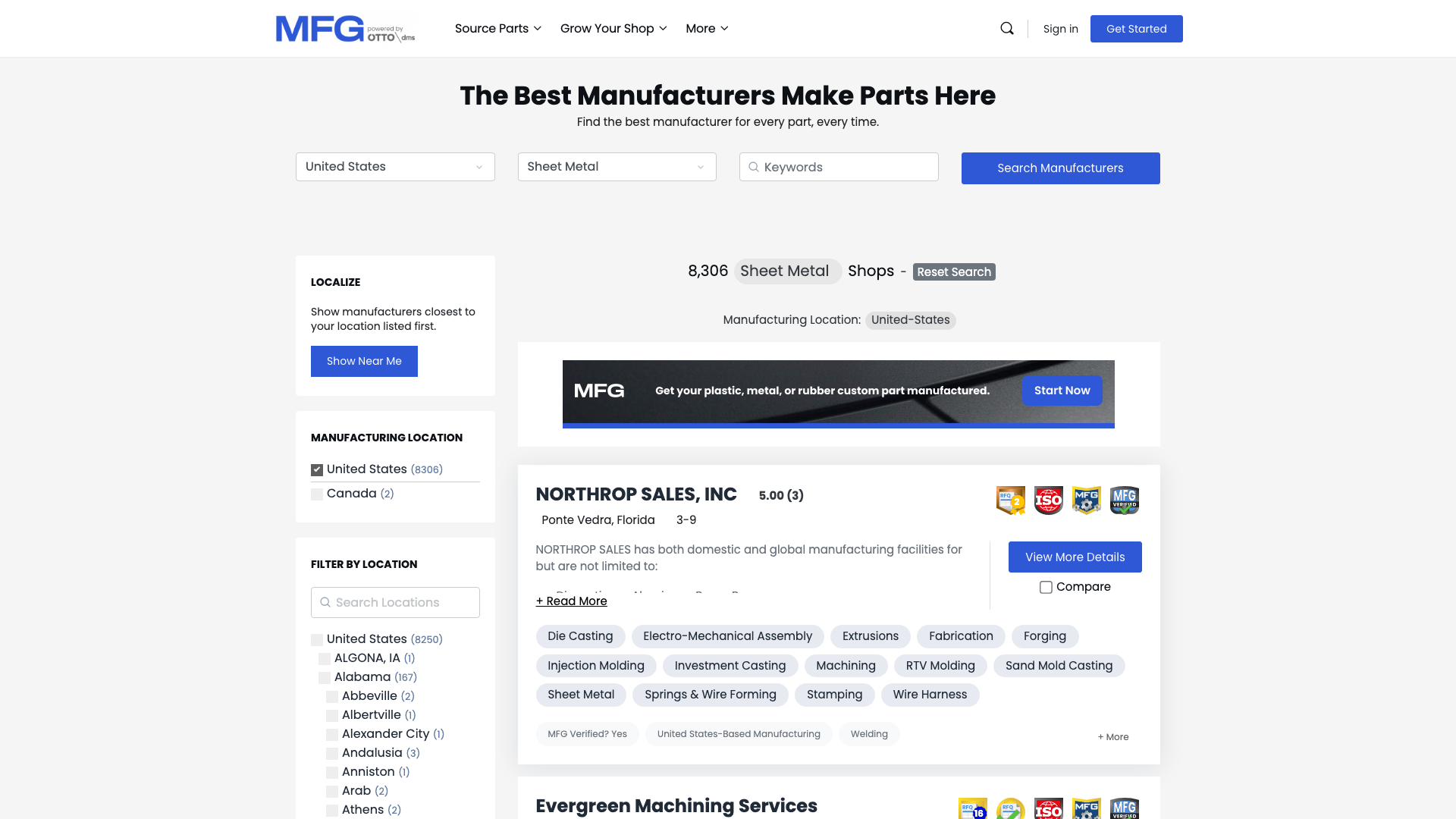
filetype: – Find PDF documents
"sheet metal" "member list" filetype:pdf USA
Industry association member lists and trade show exhibitor catalogs are often published as PDFs.
Search by trade show name
"FABTECH" "exhibitor" "sheet metal" filetype:pdf
Companies that exhibit at trade shows almost always have real scale and sales intent. Exhibitor lists are gold mines for company research.
Search by certification
"AS9100" "sheet metal fabrication" USA
This single query narrows your results to sheet metal fabricators with aerospace certification. Certification names are one of the most powerful industry filters available.
Search by major equipment brand
"precision sheet metal" ("Trumpf" OR "Amada" OR "Bystronic") USA
Trumpf, Amada, and Bystronic are the world’s leading manufacturers of laser cutting and sheet metal fabrication equipment. Fabricators using these machines often mention the brand on their websites – so this technique lets you discover competitors by following the trail of equipment names.
Google Maps – A powerful method that’s surprisingly overlooked
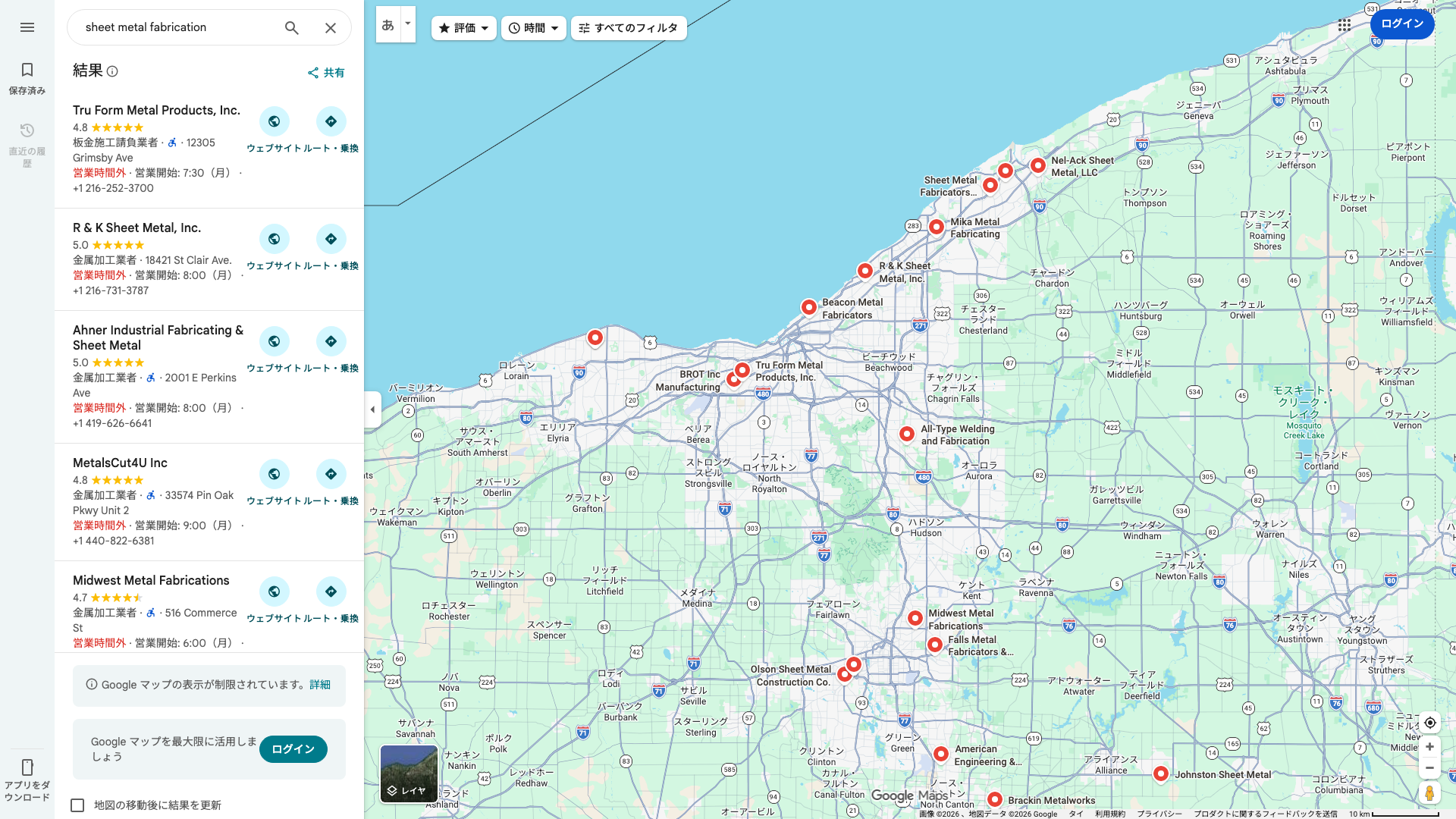
Companies that don’t appear in web search often show up on Google Maps. Many small job shops and workshops don’t have websites but do have Google Business Profiles.
Search “sheet metal fabrication” on Google Maps and navigate to US manufacturing hubs – Ohio, Michigan, Illinois. You’ll see pins for companies that never appeared in your web searches.
What Google Maps gives you
Company name and address
Phone number and website (if available)
Business hours
Google reviews and ratings
Photos (sometimes including factory exterior and interior shots)
When Google Maps is especially effective
Small job shops – Companies with no website or no SEO presence
Industrial clusters – Find one company and you’ll see others clustered nearby
Geographic targeting – When you need companies in a specific state or city
For example, search “sheet metal fabrication” on Google Maps and zoom into the Cleveland, Ohio area. You’ll find multiple sheet metal fabricators that didn’t appear in web search. Click each profile for phone numbers and website links.
When to use web search vs. Google Maps
| Method | Strengths | Weaknesses |
|---|---|---|
| Web search | Finds certification and technical info. Covers the entire country in one search | Misses companies without websites |
| Google Maps | Finds small companies without websites. Shows locations at a glance | Requires zooming into specific regions. Less detailed information |
In my practice, I start with web search to identify the major players, then use Google Maps to sweep specific industrial regions. This combination typically adds 10-20% more companies that web search alone wouldn’t find.
Putting It All Together – A Full Search Run for Precision Sheet Metal Fabricators
Let’s combine all the techniques above and walk through the process of finding 30 US precision sheet metal fabricators from start to finish.
Note – All searches below are run with Google’s region setting set to “United States.”
Round 1 – Cast a wide net with core keywords
"precision sheet metal fabrication" manufacturer USA -job -career -indeed
Check the top 20 results. You’ll see a mix of company websites, ThomasNet listings, and industry articles. Note down the company names and pay attention to the exact language each company uses on its site.
Round 2 – Expand with synonyms
("custom sheet metal" OR "CNC sheet metal fabrication" OR "sheet metal forming") ("fabricator" OR "job shop") USA -job -career
This catches companies that Round 1 missed. Adding “job shop” in particular surfaces smaller custom fabricators.
Round 3 – Change the angle with materials and processes
("stainless steel fabrication" OR "aluminum sheet metal") manufacturer USA -job -career
Searching by material name finds companies that specialize in specific metals.
Round 4 – Mine industry associations and trade shows
site:thomasnet.com "sheet metal fabrication" "precision"
"FABTECH" "exhibitor list" "sheet metal" filetype:pdf
"PMA" "member" "metalforming" filetype:pdf
Round 5 – Filter by certification (for specific industries)
"AS9100" "sheet metal fabrication" USA -job
"ITAR registered" "sheet metal" fabricator
This narrows results to companies certified for aerospace and defense work.
Round 6 – Search by NAICS code
"NAICS 332322" company list
"332322" "sheet metal" manufacturer directory
This surfaces company lists from government statistics and business directories.
Round 7 – Fill gaps with Google Maps
Search “sheet metal fabrication” on Google Maps and zoom into manufacturing-heavy regions like Ohio and Michigan. You’ll find small job shops that web search missed entirely.
By layering these seven approaches, you build a comprehensive picture. The key is not stopping at web search alone – combine it with Google Maps. In my experience, I run 10-20 different query patterns per research topic. The first query typically finds only 20-30% of the total.
This Works for Any Industry
The process of “concept decomposition, synonym brainstorming, and query design” applies regardless of industry.
Here’s an example for finding US medical device component manufacturers.
("medical device" OR "surgical instrument") ("component manufacturer" OR "contract manufacturer" OR "OEM") USA "ISO 13485" -distributor -job
-distributor removes distributors, and "ISO 13485" filters for companies with medical device quality certification.
For German industrial robot manufacturers, you’d search like this.
("industrial robot" OR "robotic arm" OR "collaborative robot") ("manufacturer" OR "Hersteller") Germany -job -career
After setting Google’s region to “Germany,” including the German word “Hersteller” (manufacturer) alongside the English terms ensures you pick up German-language sites as well as English ones.
Search Is Not a One-Shot Process
The most important takeaway is that search is an iterative process.
Start with a basic query
Scan the titles and snippets in the results
Note the exact phrases that real companies use on their sites
Re-search using those phrases
Try different angles – industry associations, trade shows, certifications
Repeat
When you hit a wall, change your angle. Try a different process name, search by material, filter by certification, or look for an industry association. What one approach misses, another often finds.
What You Can Do Yourself vs. When to Call in a Professional
Google search only finds companies that have websites and publish information in the language you’re searching in.
| What you can do yourself | When professional help is worth it |
|---|---|
| Finding the top 20-30 companies | Compiling a comprehensive list of 100+ companies |
| Searching in English-speaking markets | Gathering information in local languages (Chinese, Thai, etc.) |
| Collecting company names and basic info | Deep-diving into revenue, headcount, and equipment details |
| Gathering publicly available data | Leveraging paid databases (D&B Hoovers, etc.) |
| Researching one industry in one country | Cross-referencing multiple countries and industries |
Google search is a powerful starting point. But building a list of 100+ companies requires combining multiple sources – industry associations, certification databases, trade data, corporate registries, and more.
Summary – Search Technique Reference
| Technique | Syntax | Effect |
|---|---|---|
| Region/language settings | Settings > Search settings > Region | Optimize results for target country |
| Double quotes | "precision sheet metal" |
Search for an exact phrase |
| OR operator | "A" OR "B" OR "C" |
Search multiple synonyms at once |
| Minus operator | -job -career |
Exclude unwanted pages |
| site: | site:thomasnet.com |
Search within a specific website |
| filetype: | filetype:pdf |
Search for PDF documents only |
| Certification name | "AS9100" |
Filter by industry certification |
| NAICS code | "NAICS 332322" |
Filter by US industry classification |
| Equipment brand name | "Trumpf" OR "Amada" |
Discover competitors by equipment trail |
| Google Maps | Navigate to region and search | Find small companies without websites |
Search Query Templates (Copy and Use)
Basic company search
("[Product A]" OR "[Product B]" OR "[Product C]") ("[Company type A]" OR "[Company type B]") USA -job -career -indeed
Search via industry association
"[Association name]" "member list" filetype:pdf
Filter by certification
"[Certification]" "[Product name]" USA
Search within a directory
site:thomasnet.com "[Product name]"
Try plugging in your own research topic and see what comes up.
Need help with overseas company research?
We combine Google search with industry associations, certification databases, trade data, paid databases, and other sources to build comprehensive company lists. Our track record spans 80+ countries and 10,000+ companies.
Whether you need to list 100 manufacturers in a specific industry or map out competitors in a target country, we can help.
Learn more about our services https://taitonmai.co.jp/en/