Building a list of 100 overseas competitors or potential suppliers requires choosing the right information sources and designing a search strategy. These two factors determine 90% of the outcome. In this article, I share the complete methodology I use in practice, drawn from experience researching over 10,000 companies across 80+ countries.
“I was asked to list overseas XX manufacturers, but I have no idea where to start.” “Google search gives me about 20 companies, then I hit a wall.” “I’ve checked industry associations and trade show lists, but it still doesn’t feel complete.”
These are common challenges in company list-building work.
The truth is, company list building is less about “what to search for” and more about “where to search.” If you know the right sources, reaching 100 companies is straightforward. If you don’t, you’ll stall at 20.
This article covers the complete process for building company lists in the B2B manufacturing sector, along with how to use 12 different information sources.
(Note: If you are considering outsourcing overseas company list building, see the service details at the end of this article.)
Success Depends on How You Define the Target Companies
Before you start searching, articulate exactly what you’re listing. If this definition is vague, half of your 100 companies will turn out to be irrelevant.
The first thing to do in company list building is not searching or using databases. It is defining the target companies.
What to Define
| Item | Example |
|---|---|
| Target product | Battery chargers, gas sensors, liquid food paper containers |
| Excluded products | Companies making only components (not finished products), sales agents |
| Target countries/regions | 6 ASEAN countries, Europe, North America |
| Company size | Revenue over $10M, 100+ employees |
| Position in the value chain | Manufacturer, distributor, or both |
Common Mistakes
There is a fundamental difference between a client asking for “a comprehensive list with no gaps” and one asking for “just the top 30 players.” The research approach is completely different.
For the former, you need certification databases and trade data for exhaustive coverage. For the latter, paid reports and industry associations are sufficient. Confirm what kind of list the client needs before you start.
Finding the Right Terminology
The official industry name for a product often differs from how the client refers to it.
Milk carton → Liquid food paper container
Emergency light → Emergency luminaire
The following methods help you find the correct terms:
| Method | Description |
|---|---|
| Research Navi (National Diet Library of Japan) | Search a term to find related broader and narrower concepts |
| GII (Global Information Inc.) | Identify official English names from market report titles. Chinese translations are also available |
| Wikipedia (English) | Technical terms, related standards, and industry classifications are well organized |
| Industry codes (ISIC, NAICS, HS Code) | Classification codes used in database searches. Prevents terminology inconsistencies |
Industry codes will be essential for later database searches, so identify them at this stage.
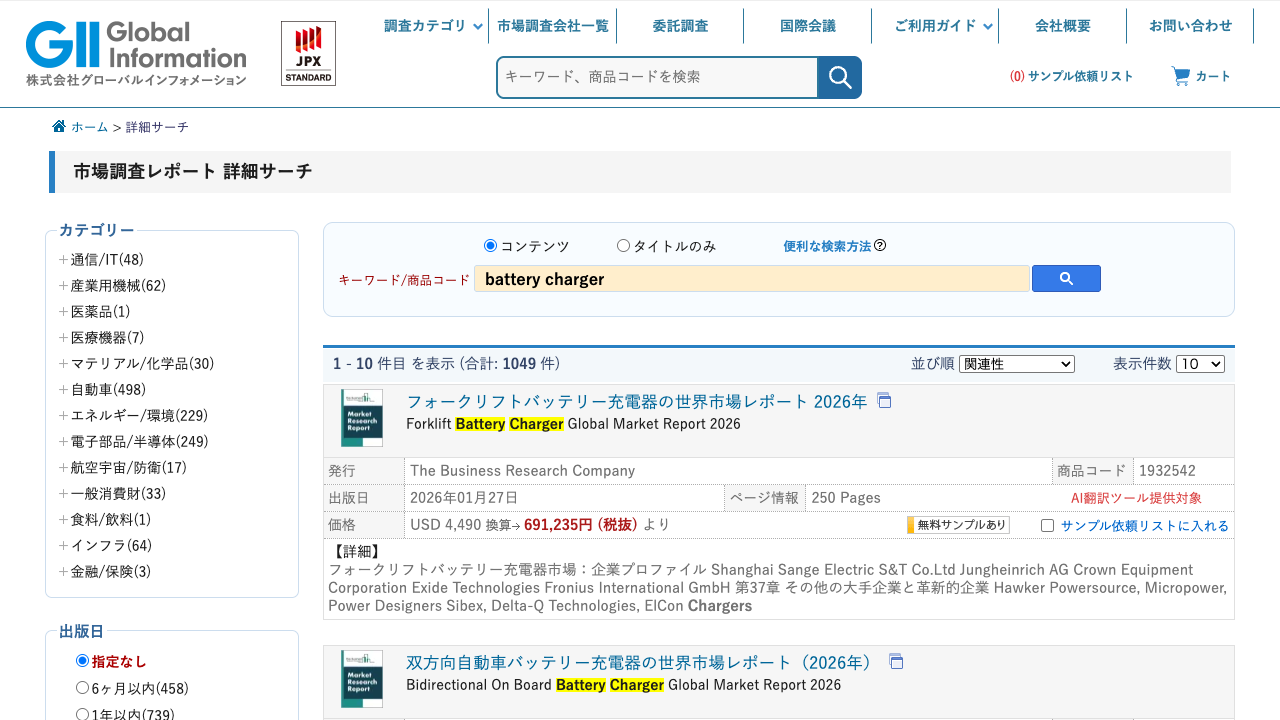
Here is an example of searching “battery charger” on GII. It returns 1,049 market reports, and the report titles reveal the official English terminology and related terms.
Understand Market Structure First — Draw a Map of “Who Makes What”
Don’t start by searching for company names. First, understand the structure of the industry. Once you see the structure, it becomes clear which layer of companies you should be looking for.
The second thing to do in company list building is to grasp the market structure of the target industry.
For example, if you’re researching the gas sensor industry, products fall into three layers:
Gas sensor (component) → Gas detector (device) → Gas analysis system (system)
If the request is to “list gas sensor manufacturers,” gas detector makers are out of scope. However, some detector makers produce sensors in-house, so you need to understand the downstream as well.
How to Grasp Market Structure
| Order | Method | Time Required |
|---|---|---|
| 1 | Review samples of paid reports (table of contents, key players section) | 30 min |
| 2 | Read reports linked to industry codes (e.g., MarketLite, GlobalData via Gale Business Insights: Global) | 1 hour |
| 3 | Search Japanese news articles (Nikkei, Factiva newspaper articles) for industry overviews | 30 min |
The principle is to check consolidated information sources first. Gathering fragments through individual Google searches is inefficient. Reading one report gives you market size, application segments, key players, and regional share data all at once.
If you can obtain a paid report, read the first one thoroughly. If it includes share data, you can prioritize researching the top companies. Even without share data, companies mentioned in the report are major players.
An important caution: If your objective is company list building, don’t spend too much time on policy trends or regulatory analysis. Stay focused on the primary goal of your research.
12 Information Sources and How to Use Them — The Search Order Determines Efficiency
There are 12 types of free information sources available for company list building. You don’t need to use all of them, but knowing they exist expands the scope of your research.
Below is a summary of each source’s characteristics and when to use it.
| # | Source | Cost | What You Learn | When to Use |
|---|---|---|---|---|
| 1 | Paid report samples | Free* | Key players, market share, market segments | Check first. Identify top companies |
| 2 | Industry association member lists | Free | List of major companies in the industry (board members = leading companies) | Comprehensive coverage of major players. Board member lists are especially valuable |
| 3 | Company directories | Free | Company listings by industry (ThomasNet, LinkedIn, etc.) | Finding companies in specific industries or regions |
| 4 | Trade show exhibitor lists | Free | Companies exhibiting products in that industry | Discovering mid-size and emerging companies |
| 5 | Certification databases | Free | Companies with product safety certifications (UL, IECEE, EESS, etc.) | Identifying companies that actually manufacture products |
| 6 | Government/regulatory databases | Free | Licensed companies, registered factories, importer lists, etc. | Identifying companies in regulated industries. Surprisingly rich data |
| 7 | ImportYeti (trade data) | Free | Companies with U.S. import records, shipment frequency | Identifying companies that actually export |
| 8 | Patent databases | Free | Companies filing related technologies | Identifying manufacturers of technically complex components |
| 9 | Google Search | Free | Broad company information | Supplementing companies not found through other sources |
| 10 | Google Maps | Free | Factory and office locations | Discovering local SME manufacturers (especially in Asia) |
| 11 | Academic papers | Free | Technology development activities by research institutions and companies | Discovering companies in advanced technology fields |
| 12 | Job posting sites | Free | Companies currently hiring (possibly expanding) | Discovering emerging or market-entering companies |
*Paid reports themselves are expensive, but tables of contents and key player sections can be viewed for free on sites like GII.
Priority Order for Sources
You don’t have time to search everything. The following order is most efficient:
Group 1 (Essential) — Paid report samples → Industry associations → Company directories → Google Search Group 2 (Recommended) — Trade shows → Certification databases → Government/regulatory databases → ImportYeti → Patents Group 3 (Supplementary) — Academic papers → Google Maps → Job posting sites
Group 1 alone covers 60-70% of major companies. Adding Group 2 gets you to 80-90%. Group 3 is for supplementary purposes when a “no-gaps” list is required.
Note that research firms and consulting companies also use paid databases such as Factiva and D&B Hoovers in addition to these. Paid databases are covered in the “Paid Databases Used by Professionals” section later in this article.
How to Use Each Source in Practice
ImportYeti — Search for Companies Exporting to the U.S. for Free
ImportYeti (https://www.importyeti.com/) is a free service that lets you search U.S. import customs data. Search by company name to find suppliers and shipment frequencies.
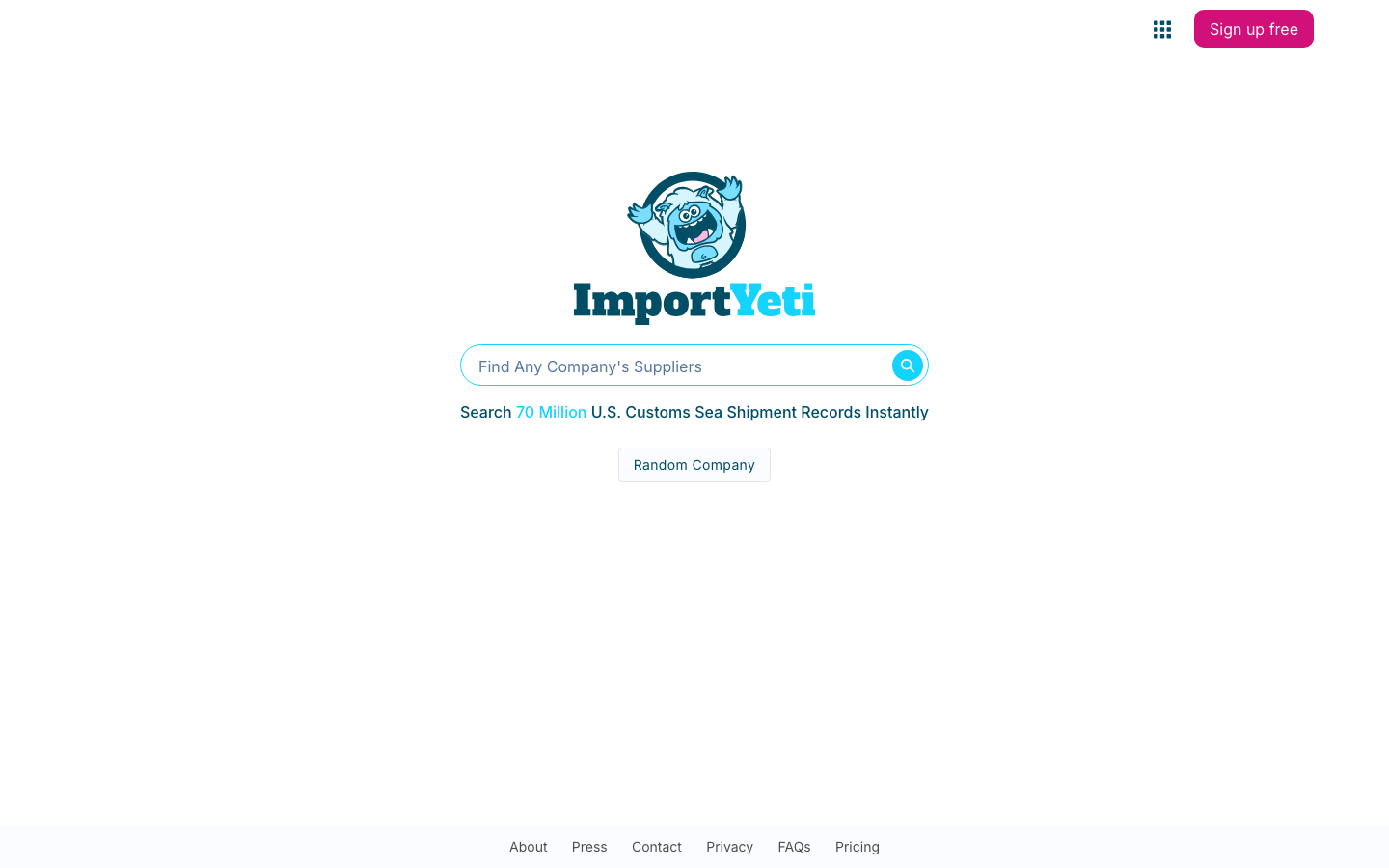
Usage is straightforward. Simply enter a company name (in English) into the search bar.
For example, searching “battery charger” displays a list of companies with “battery charger” in their name or related suppliers. For each company, you can also check shipment counts and trading partners (U.S.-side importers).
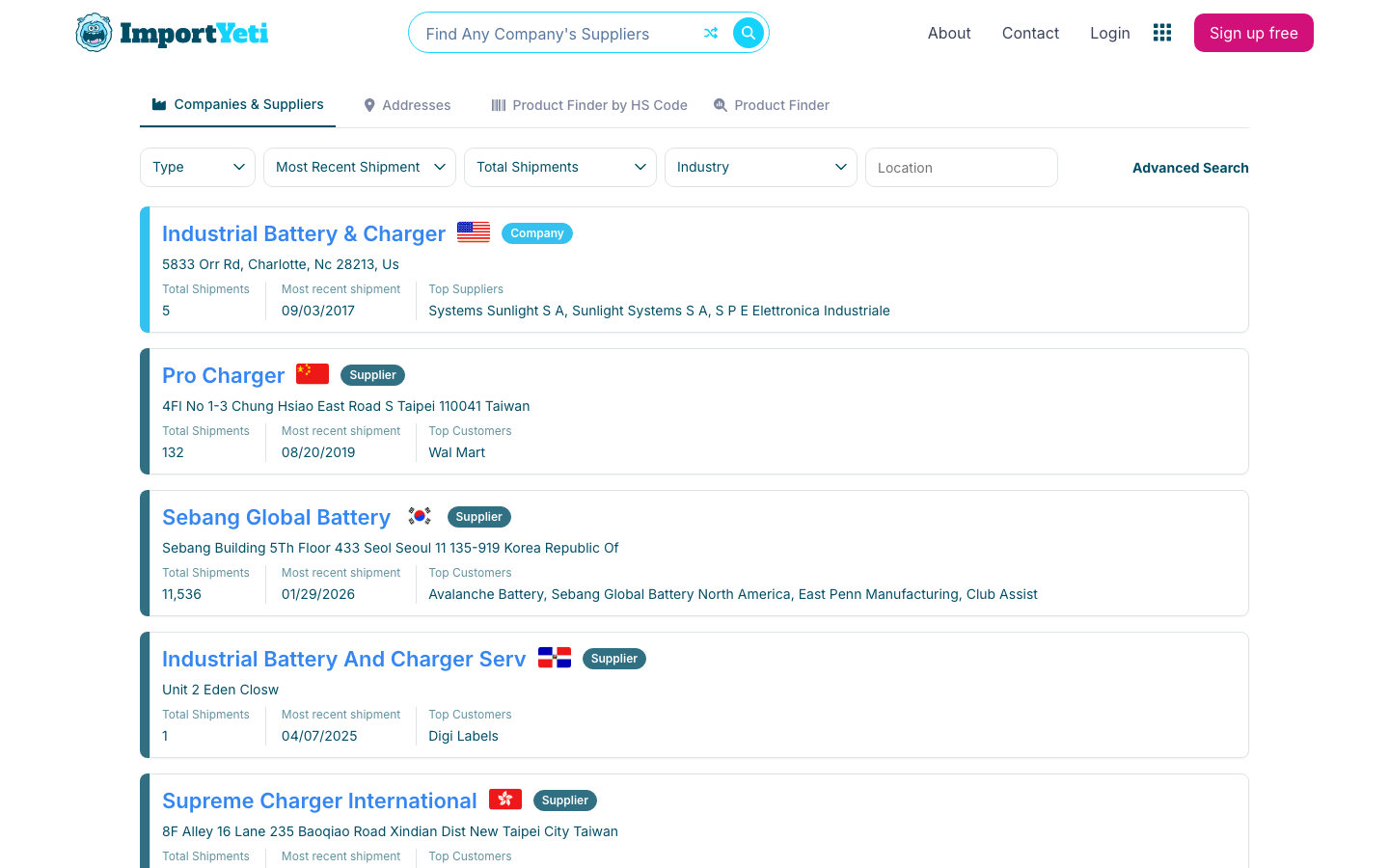
ImportYeti’s strength is that it reveals companies that are actually shipping products. Even for companies whose real operations are hard to gauge from their websites, having their name in trade data is evidence of active business.
Note that data is limited to imports into the United States. Companies with no U.S. trade will not appear. Also, the free version has limits on the number of results displayed.
Certification Databases — Identify Actual Manufacturers
Certification databases are the only source that can identify companies actually manufacturing products. Search UL Product iQ, IECEE CB Scheme, and country-specific certification databases using product category standard numbers.
Detailed usage is covered in the separate article “Who Makes Makita’s Charger? Using Certification Databases to Uncover OEM Relationships.”
Key points are summarized below:
| Database | Search Method | Feature |
|---|---|---|
| UL Product iQ | Keyword or CCN code | U.S. certifications. Powerful category search |
| IECEE CB Scheme | IEC standard number | International cross-border search. Covers 50+ countries |
| EESS (Australia) | Trade Name + Model | Reveals OEM manufacturer’s name and address |
Company Directories
| Directory | Region | Feature |
|---|---|---|
| ThomasNet | North America | Specialized in North American manufacturing |
| Global | Company profiles and employee information |
Government and Regulatory Databases — A Surprisingly Rich Free Resource
Government and regulatory databases are often overlooked in company list building, but for products that require permits or registration, governments frequently publish company lists for free.
The concept is simple: ask yourself, “Does manufacturing or selling this product require registration or filing with an authority?” If yes, that authority’s database likely contains a company list.
| Field | Example Sources | Content |
|---|---|---|
| Pharmaceuticals | National drug regulatory authorities (FDA, EMA, etc.) | List of companies with manufacturing licenses |
| Food | National food safety authorities | Lists of permitted food manufacturers/importers (the Philippines publishes all food importers) |
| Factories | National industry/industrial ministries | Registered factory lists (Thailand’s DIW publishes all factories nationwide, searchable by industry code) |
| Electrical products | Certification bodies (UL, IECEE, etc.) | Companies with product safety certifications (certification databases mentioned above) |
| Environment/CO2 | Environmental regulatory authorities, emissions reporting systems | Lists of companies required to report CO2 emissions. In industries with high emissions like petrochemicals and heavy industry, these companies appear in public databases |
Thailand’s Department of Industrial Works (DIW) database is particularly powerful — virtually all factories in Thailand are registered with industry codes, making it an effective company database.
The key takeaway is that “there are more free sources than you might expect.” Understanding the regulatory structure of your target industry reveals surprisingly rich information available for free from government websites.
Country-Specific Sources
| Source | Country | Content |
|---|---|---|
| BOI (Board of Investment) | Thailand | List of companies with Thai investment incentive approvals |
| DIW (Department of Industrial Works) | Thailand | Nationwide factory list (searchable by industry code) |
| Data Warehouse | Thailand | Thai corporate database |
| FDA Philippines | Philippines | Lists of food/pharmaceutical importers and manufacturers |
Each country has its own company databases, investment approval lists, and factory registration systems. Once you determine the target country, check whether country-specific sources exist. Searching for “XX country XX manufacturer list” or “XX country factory registration database” can uncover them.
The 7-Step Workflow — From Brief to Delivery
Here is the company list-building process broken into seven steps. Doing the first three steps (brief review, definition, structure analysis) thoroughly dramatically improves efficiency in the later steps.
Step 1 — Thoroughly Read the Brief
Read all materials received from the client. Research every unknown term until you have zero remaining questions.
Priority order for research:
Dictionary (personal, online reference)
Wikipedia (target language → English)
Specialized dictionaries
Web search
Books
Raise questions with the client early. The longer you wait, the harder it becomes to ask.
Step 2 — Define the Target Companies
Perform the “target company definition” described earlier. Clearly distinguish what is in scope and what is out of scope.
Record variable screening criteria as columns in your Excel list. For example, for pharmaceuticals, include criteria like “form (liquid, powder, solid)” to pre-design the screening structure for later steps.
Step 3 — Understand Market Structure
Use paid reports and news searches to grasp the industry overview. Map upstream and downstream relationships.
Step 4 — List Companies from Each Source
Research the 12 sources in priority order. Extract company names and URLs from each source.
Step 5 — Consolidate the Company List
Merge companies from all sources into a single Excel list.
Rules for consolidation:
Record whether a company is an industry association member or mentioned in paid reports
Do not delete seemingly irrelevant companies. Mark them as “out of scope” instead (deleting them creates re-research burden later)
Translate business descriptions using machine translation
Step 6 — Check Websites of Top Companies
Review the websites of the top 10-20 companies on the consolidated list.
Confirm that they actually manufacture or sell the target products
Assign a relevance rating (High / Medium / Low, etc.)
Add a brief description of each company
Step 7 — Finalize and Deliver the List
Classify companies by screening criteria and deliver in the format the client requires.
Paid Databases Used by Professionals
The sources covered so far are primarily free. Research firms and consulting companies also use the following paid databases.
When doing company list building professionally, free sources alone have limitations. The following databases require annual subscriptions costing tens of thousands to hundreds of thousands of dollars, but they significantly improve research accuracy and efficiency.
| Database | Features | Primary Use |
|---|---|---|
| Factiva (Dow Jones) | News search + company search. Filter by industry code, revenue | Discovering companies through industry news. Bulk company list extraction |
| D&B Hoovers (Dun & Bradstreet) | One of the world’s largest company databases. Search by industry code, revenue, employee count | Creating company lists by specified criteria. “Build small sets and combine” is the key technique |
| Panjiva (S&P Global) | Import/export customs data for multiple countries. Search by HS code | Identifying companies actually engaged in trade |
| Euromonitor (Passport) | B2C consumer goods market data. Brand share, retail channel data | Listing consumer goods manufacturers. Essential for B2C research |
Factiva is often subscribed to by large corporations and universities, so it may be available through your organization. If direct subscription is not feasible, engaging a research firm that has access to these databases is an alternative.
Common Pitfalls and How to Avoid Them
Even experienced search tool users can degrade research quality through these mistakes.
1. Missing Companies Due to Terminology Variations
The same product can have multiple names. If you only search “battery charger,” you’ll miss companies registered under “charging station” or “power supply.”
Solution — Use GII’s report title search to identify synonyms. Chinese terms can also be verified on GII.
2. Industry Code Misalignment
Industry codes in company databases and market reports may not match the classification you have in mind.
Solution — Don’t take industry codes at face value. Search multiple related codes.
3. Geographic Bias in Search Results
Google search results are influenced by your browser’s language and regional settings. Searching from a Japanese-language environment may return only Japanese and English-speaking companies.
Solution — Change your browser’s language and region to the target country. Using a VPN can also be effective.
4. Deleting Out-of-Scope Companies
If you delete a company during research because you judge it irrelevant, you’ll need to re-research if the client later says “actually, include that one.”
Solution — Never delete companies you think are out of scope. Mark them as “out of scope (reason: XX)” and keep them in the list.
Summary — Company List Building Is 90% Source Selection and Target Definition
Here is a recap of the key points from this article:
Define target companies first. The type of list the client wants (comprehensive? top players? depth of data?) dictates the research approach
Understand market structure before searching. Use reports and news to map the industry landscape before you start looking for companies
Use the 12 free sources in priority order. Report samples → industry associations → company directories → Google Search covers 60-70% of major companies
For higher accuracy, use paid databases. Factiva, D&B Hoovers, Panjiva, etc. are professional tools used by research firms. The decision is whether to subscribe directly or engage a research firm
Don’t discard information during list consolidation. Keep out-of-scope companies with reasons noted. Record sources (industry association, report, etc.)
Company list building may look like “simple work anyone can do,” but it is a job where knowledge of information sources and search design create significant differences in quality. I hope this article helps improve your research efficiency.
If you need help with overseas company list building:
Our firm conducts company list-building research using multiple sources including paid reports, industry associations, certification databases, and trade data. We have research experience covering 80+ countries and over 10,000 companies.
We handle requests such as “I need a list of 100 major global manufacturers in this product category” and “I want a comprehensive view of competitors in the target country.”
For service details and inquiries: https://taitonmai.co.jp
About the Researcher
Takashi Kinoshita — CEO, Taitonmai Co., Ltd.
M.A., a national university graduate school
8 years at a major Japanese electronics manufacturer in the procurement division
2 of those years stationed at the company’s Thailand factory as Procurement Section Manager, leading a local team
Sole Japanese manager in the department, conducting procurement operations in English and Thai
After going independent, conducted corporate research covering 80+ countries and 10,000+ companies
Research date: February 15, 2026
For overseas company list building and market size research: https://taitonmai.co.jp